Project Direction
Data Organisation
Resilient data infrastructure begins with data that can be indexed, stored,
updated, and completed reliably. My work here advances learned
indexes for disk-resident, updatable systems, and
missing-value imputation for tabular data lakes —
making data organisation more scalable, robust to changing and incomplete
data, and usable for trustworthy downstream analytics.
Learned Index
A Fully On-disk Updatable Learned Index
(ICDE'24)
(Code)
Hai Lan, Zhifeng Bao, J. Shane Culpepper, Renata Borovica-Gajic, Yu Dong
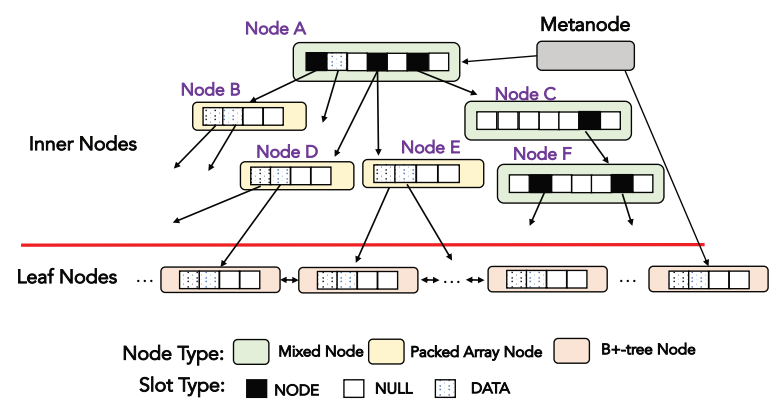
AULID proposes a fully on-disk updatable learned index designed
specifically for disk-based database systems, where disk I/O dominates
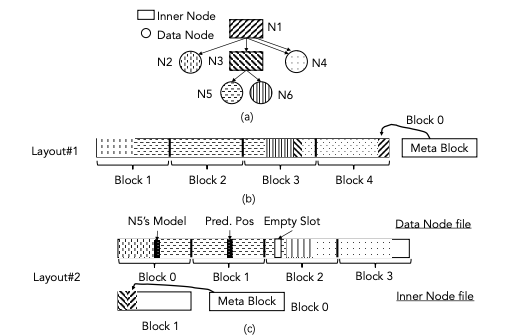
performance. It introduces a disk-efficient structure that reduces I/O
cost by minimizing model traversal and optimizing node layouts for disk
access. AULID supports efficient lookups, inserts, and updates while
maintaining high accuracy and low storage overhead. Experiments show
that AULID significantly improves lookup and update performance compared
to traditional B+-trees and prior learned indexes in disk-resident
settings.
Updatable Learned Indexes Meet Disk-Resident DBMS — From Evaluations to Design Choices
(SIGMOD'23)
(Code)
Hai Lan, Zhifeng Bao, J. Shane Culpepper, Renata Borovica-Gajic
This paper studies whether updatable learned indexes are effective in
disk-resident DBMS environments, where most real-world databases
operate. It implements and evaluates several state-of-the-art learned
indexes (e.g., PGM, LIPP, ALEX) and compares them against traditional
B+-trees under various workloads. The results show that while learned
indexes can outperform B+-trees in specific workloads, B+-trees remain
highly competitive overall. Based on extensive analysis, the paper
identifies key limitations of learned indexes on disk and proposes
design principles to guide the development of efficient on-disk learned
indexes.
Missing Value Imputation
Missing Value Imputation in Tabular Data Lakes Unleashed: A Hybrid Approach
(VLDBJ'26)
(System Prototype)
Feng Luo, Hai Lan, Hui Luo, Zhifeng Bao, J. Shane Culpepper, Shazia Sadiq, Xiaoli Wang
Missing values in tabular data lakes can severely impact data analysis
and diminish the performance in downstream applications. Ideally, a
robust imputation strategy should properly take three aspects of variety
into consideration: source of imputed value, the types of tables
involved, and the data types of the missing value. However, the existing
estimation-based or search-based imputation approaches do not
effectively account for all three aspects of variety. To address this
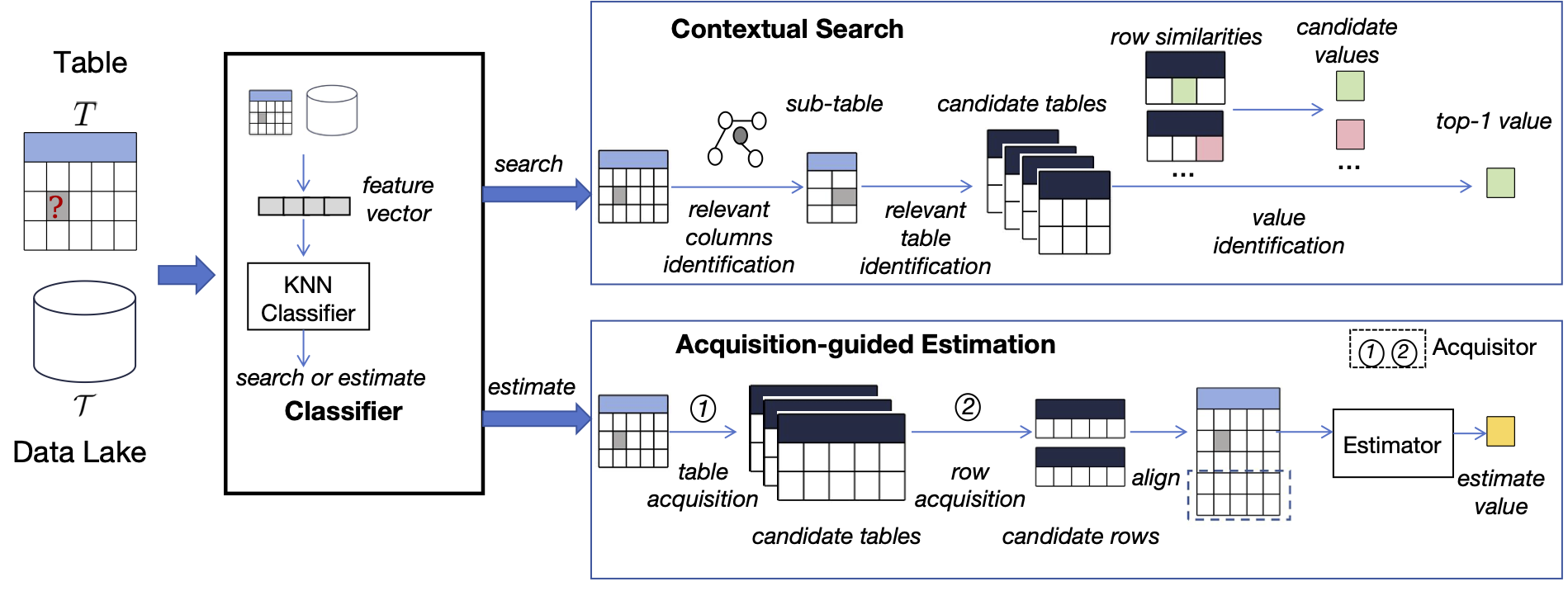
gap, we propose CESID, a hybrid method that effectively and efficiently
combines the strengths of both search-based and estimation-based
approaches, enabling its robustness in dealing with the three varieties.
Extensive experiments conducted on three data lakes demonstrate that
CESID effectively and efficiently addresses the missing value problem.