Project Direction
Query Optimisation
Reliable data infrastructure depends on predictable query execution. My
work develops AI-driven cardinality estimation and
plan selection methods for vectors, strings, and complex
workloads where classical optimisers often fail — reducing severe
estimation errors, avoiding unstable execution plans, and improving the
efficiency of vector search, retrieval-augmented generation, and database
workloads, without intrusive changes to production systems.
Cardinality Estimation
Cardinality Estimation for Similarity Search on High-Dimensional Data Objects: The Impact of Reference Objects
(VLDB'25)
(Code)
Hai Lan, Shixun Huang, Zhifeng Bao, Renata Borovica-Gajic
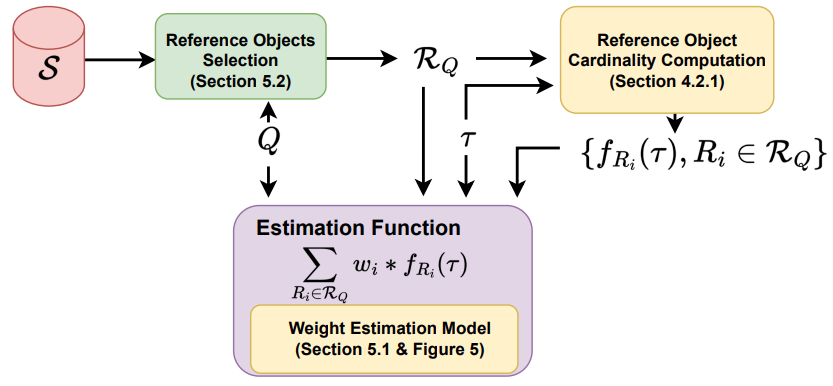
This paper studies cardinality estimation for similarity search on
high-dimensional data (CE4HD), which is essential for query optimization
in vector databases and embedding-based applications. It proposes a
novel reference-object–based approach, where selected data objects
with similar cardinality patterns are used to estimate the query
cardinality efficiently and accurately. The paper introduces two
methods—SRCE (single-reference) and MRCE (multi-reference)—that
leverage reference objects and lightweight models to improve robustness
and efficiency. Experiments show that the proposed methods achieve up to
10× faster estimation and up to 136× lower Q-error compared
to prior approaches such as SimCard and SelNet.
Query Optimization
Practical Parameterized Query Optimization via Efficient Plan Reuse and List-wise Ranking
(SIGMOD'26)
(Code)
Hai Lan, Yang Yu, Zhifeng Bao, Zi Huang, Yuwei Peng
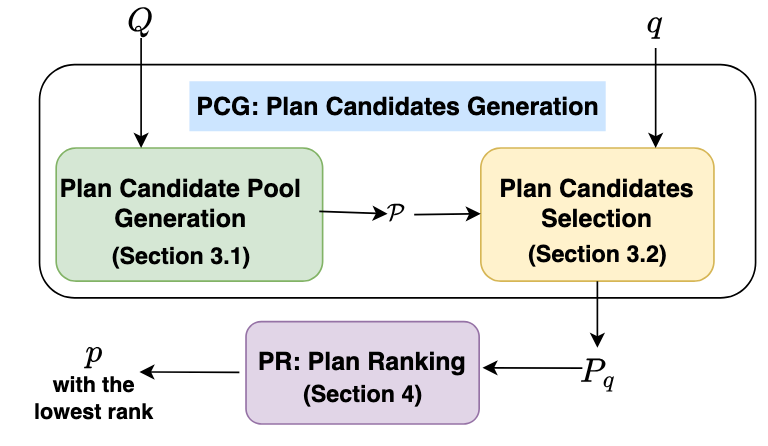
PLARQ is a practical learned optimizer designed for parameterized query
optimization (PQO), where the same query template is repeatedly executed
with different parameter values. It introduces a plan reuse strategy
that retrieves high-quality candidate plans from a precomputed pool
based on query similarity, and a list-wise attention-based ranking model
to select the best plan efficiently. PLARQ integrates seamlessly with
PostgreSQL without modifying optimizer internals and achieves
significant performance improvements, with up to 420× speedup
over PostgreSQL and up to 2× over existing learned methods.
A Survey on Advancing the DBMS Query Optimizer: Cardinality Estimation, Cost Model, and Plan Enumeration
(Data Science and Engineering'21)
Hai Lan, Zhifeng Bao, Yuwei Peng
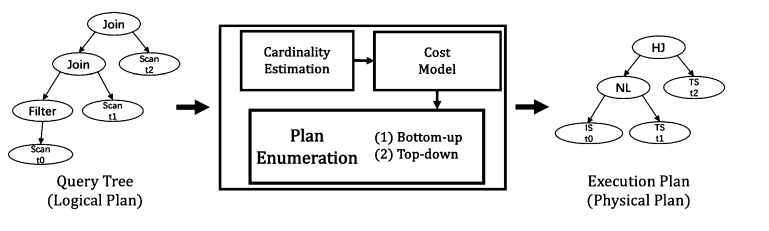
This paper surveys techniques for improving cost-based database query
optimizers, focusing on three core components: cardinality estimation,
cost models, and plan enumeration. It explains that inaccuracies in
cardinality estimation are the main cause of suboptimal query plans, and
reviews traditional methods (e.g., histograms and sampling) as well as
modern learning-based approaches. The paper also highlights key
limitations of existing optimizers and outlines future directions,
especially integrating machine learning to build more accurate and
robust optimization frameworks.
Index Advisor
An Index Advisor Using Deep Reinforcement Learning
(CIKM'20)
(Code)
Hai Lan, Zhifeng Bao, Yuwei Peng
This paper studies the index selection problem, which aims to choose
the best set of indexes to minimize workload execution cost under
storage or number constraints, a known NP-hard problem. It proposes a
deep reinforcement learning–based index advisor that integrates
heuristic candidate generation with a Deep Q Network (DQN) to recommend
both single-attribute and multi-attribute indexes while modeling their
interactions. The approach enables more effective exploration of index
combinations and supports multiple-index access to tables. Experiments
show that the proposed method achieves better workload performance than
traditional greedy and optimization-based index advisors.